Case Study: Glassonline24
From Traffic to Demand: The Glassonline24 Case
How Fixing the Conversion System Unlocked Scalable Growth.

Case Study: Glassonline24
Executive Summary
Transforming Traffic Into Scalable Growth
Context
Glassonline24 generated consistent paid traffic but struggled to convert visits into meaningful leads.
Strategy
AIM redesigned the demand system, focusing on conversion architecture, UX, and tracking.
Impact
Glassonline24 transformed paid traffic into a scalable, efficient demand engine with increased lead quality.
Challenge
High acquisition costs and low conversion rates limited the impact of media investment. Additionally, leads were mostly for small investments instead of large projects.
Results
Conversions increased sixfold while cost per conversion dropped by over 70%, despite increased media investment. Lead quality improved significantly, shifting demand from small purchases to high-value project inquiries.
The Context
Glassonline24 operates in a competitive digital environment where demand capture depends not only on visibility but on the ability to convert intent into action. While paid media successfully drove impressions and clicks, the absence of an optimized conversion system prevented traffic from translating into measurable business outcomes.
The limiting factor was not traffic volume, but the lack of a conversion system capable of capturing existing intent.
Beyond volume, the business challenge was attracting fewer but significantly higher-value project inquiries instead of low-value one-off purchases.
The Challenge
Low Lead Generation
Despite stable traffic volume, conversion rates remained critically low.
Rising Costs
Acquisition costs continued to increase without proportional returns.
Friction Points
Existing contact mechanisms created barriers to user interaction.
The core challenge was to unlock demand from existing traffic while ensuring that additional investment translated into higher-value demand rather than more low-quality leads.
Strategic Approach
AIM approached the problem holistically, identifying conversion as the primary bottleneck rather than media delivery. This shifted the focus from traffic acquisition to demand capture. The objective was not to maximize lead volume, but to shift demand toward complex, high-value project inquiries.
01
Demand System Redesign
Holistic approach identifying conversion as the primary bottleneck.
02
Tracking & Measurement
Implemented comprehensive conversion tracking across all touchpoints to measure real demand signals, enabling optimization based on business outcomes rather than surface metrics.
03
UX Optimization
New contact forms to reduce friction and encourage interaction.
Conversion Architecture & UX Optimization
AIM restructured the user journey to reduce friction at every conversion point. New contact forms, simplified pathways, and multiple engagement touchpoints were introduced to guide users toward meaningful project inquiries.
Before
- Complex contact mechanisms
- High friction at conversion points
- Unclear user pathways
- Limited interaction opportunities
After
- Streamlined contact forms
- Reduced friction at key moments
- Clear, intuitive user journeys
- Multiple engagement touchpoints
The new architecture guided users toward more substantial project requests instead of quick, low-commitment contacts.
The Results
Dramatic Performance Improvement
Media investment increased significantly, but conversion growth outpaced spend by a wide margin.
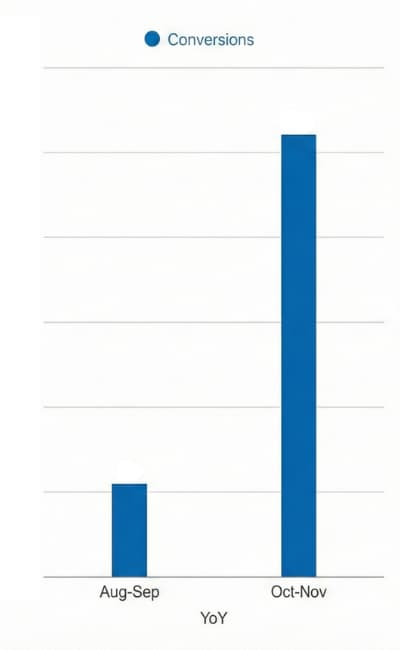
Higher conversion volume translated into a significantly lower cost per inquiry.
+372.7%
Volume Increase — Conversion volume growth
−71%
Cost Reduction — Drop in cost per conversion
High-value project inquiries increased significantly
A larger share of conversions came from high-value project inquiries rather than small transactional requests.
Across two consecutive two-month periods (Aug–Sep / Oct–Nov), the optimised conversion system delivered exceptional results:
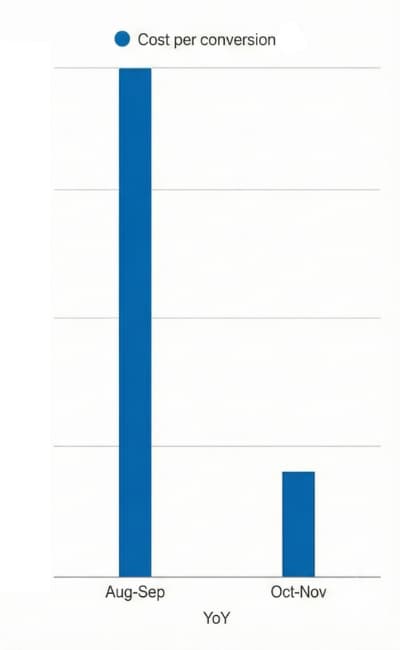
Cost per conversion dropped by 71.4% — increased impressions and clicks translated directly into measurable results once the conversion system was optimized.
Performance Metrics Comparison
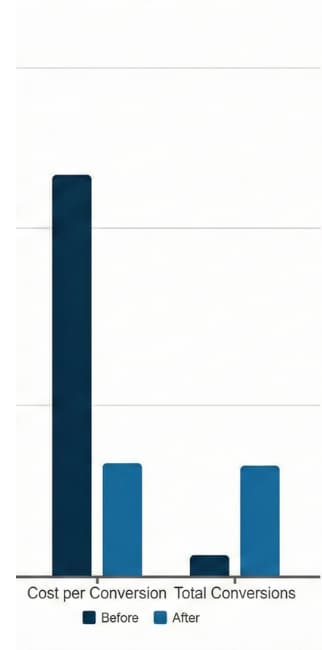
While spend increased, the system delivered disproportionate gains in both conversion volume and average lead value. Lead quality improved significantly, with demand shifting from small purchases to larger project requests.
Results refer to two consecutive periods, not a year-over-year comparison. Conversion improvements are attributable to conversion system optimisation, not increased media spend alone.
The Impact
Business Impact
Higher-Value Demand Unlocked
By fixing the conversion system, Glassonline24 shifted demand toward larger, more complex project opportunities.
Outcome-Driven Results
Marketing performance shifted from traffic-driven metrics to measurable business outcomes. The new setup provides a scalable foundation for future traffic expansion. Marketing performance is now measured not just by cost efficiency, but by the business value of incoming leads.
Sustainable Foundation
The new demand system provides a scalable foundation for future acquisition, optimization, and expansion.
Growth comes from converting higher investment into higher-value demand
AIM designs demand systems that turn intent into measurable results.
FAQ
Frequently Asked Questions
AIM SPECIALIZED AI
Choose a question or ask your own
Enter to send · Shift+Enter for new line